Believe it or not, the use of music and drama to depict pagan rites has a long and storied pedigree in the grand scheme of music history. As far back as 1690, John Dryden and Henry Purcell’s opera King Arthur opens with the pagan Saxons offering sacrifices to Germanic gods for victory over the Britons. This depiction of witchcraft and the supernatural on the opera stage of the English Restoration period was a shock to audiences which expected more refined and dignified references of the more respectable Greco-Roman mythology of antiquity. But that very subversion, to depict the grotesque rather than the beautiful, is what made such depictions so alluring.
Fast forward to the 20th century, in which Stravinsky’s Rite of Spring depicting a Scythian sacrificial ritual for the coming of Spring caused a riot at its premier due to the heavy-footed dancing which was an affront to the graceful beauty of ballet. The music didn’t help: woodwinds playing melodies in different keys to simulate the sound of spring birds beginning their yearly mating calls imitated the cacophony of the spring forest with eerie effectiveness. The music wasn’t meant to be beautiful, it was meant to illicit a particular response from the listener in being exposed to raw nature. Do you see a trend here?
Heilung’s particular Viking brand of primitivist depictions of ancient rites is part of a long genealogy of musico-dramatic depictions of grotesque ritual. And the word grotesque here is not meant to be taken as a criticism: the grotesque is an art form in its own right (rite?). When Kai Uwe Faust heaves and breathes, rocking back and forth in the music video for Læknisgaldr, or in previous tracks when he screams, cries, and wretches into the microphone, this is the grotesque. Michael Bakhtin described the grotesque as an aesthetic choice which brings the ideal and spiritual from the heaves and down the the physical, earthly level. Is this not what Heilung has always been about?
This longwinded introduction to my first impressions of Heilung’s newest video “Læknisgaldr” is meant to introduce you all who come to this strange musicologist for insights on pagan music to the broader artistic movements which Heilung is in dialogue with - consciously or otherwise. Heilung is but our generation’s musical manifestation of Stravinsky, or Purcell, which explores the grotesque and the primitive as both escape and commentary on modern society. And this, to me, is what makes this music style so provocative.
The following paragraphs will be dedicated to my own interpretations and thoughts on the sound and visuals of Heilung’s latest music video. For many of you, “the curtains are just blue” - meaning, there’s no deeper meaning to be gleaned from art. In this case, there’s nothing for you beyond this point. For those who wish to engage with your own interpretations, I welcome your thoughts in the comments below or in an email to me at the address here on the website. Now, let’s talk about Læknisgaldr.
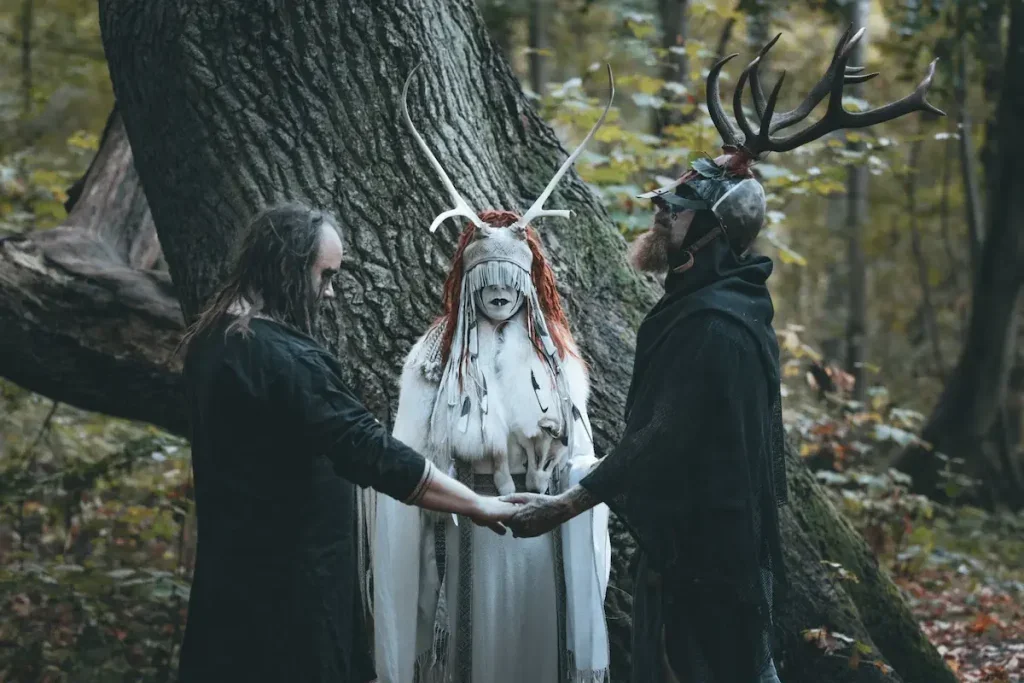
To return to the concept of the grotesque, what has always stood out to me about Heilung’s particular arrangement as a band is the juxtaposition of grotesque and beautiful, apollonian and dionysian, between Maria Franz and Faust (it just struck me how fitting that last name is, for those familiar with Goethe’s work). While this juxtaposition is a tried and true trope in metal, the “beauty and the beast” vocal dynamic used in bands such as Eluvietie, there is something deeper at play with Heilung considering the significance of performance art - theater, if you will, in Heilung’s music. That Franz is dressed in white, and Faust in more earth tone colors which blur the boundary between his body and the earth around him, I see dual sides of the psyche at play in their music. With Franz’s angelic vocals underscored by Faust’s more feral sounds, it’s hard not to feel like you, the listener, are being pulled between two sides of the mind.
The video itself tells an interesting story. I will leave more specific commentary on historical references (such as the bear shirt) to those whose expertise is in historical religious practice, but from a music and performance perspective, I find this to be a more visceral and intimate take on Heilung’s tried and true “ritual” formula. Thinking back to the Anoana video, or even in their Lifa ritual we’re all familiar with, there is always a distance between the viewer and the art. But in Læknisgaldr (galdr meaning a musical chant often associated with mystic or religious function), the cinematography places you in the ritual. Close ups abound not only of Franz and Faust during their preparation of the ritual, but of the Vikings in the scene as well: you see their faces and bodies as the ritual leads to visceral and carnal experiences. For many of you, as with me, you might even recognize some faces of people we call our friends. The camera quite literally represents this intimacy between viewer and performance - we are very much a part of the ritual, which at least for me, led to a much more unsettling experience: what is this ritual for? What are the consequences? These are questions we’re left with.
The role of nature has long been a core component of Heilung’s art. Think of their opening prayer:
All people, beasts, trees and stone and wind
We all descend from the one great being
That was always there
Before people lived and named it
Before the first seed sprouted
Over the summer, Franz explained to me that she has always wanted Heilung’s music to be a gateway for people to think more about their relationship with nature, and a call for people to reconnect with that relationship which has become obscured and muddied in modern life. I remember the first time I saw a Heilung ritual, at Midgardsblot 2022, that the prevalence of bird song and foliage as part of the stage design, and especially the lyrics to Carpathian Forest, are all working to evoke a primal history in which we were in constant relation with our surroundings. Not to say that relation was always good - I’m quite skeptical of rose-colored primitivism - but it was a relation nonetheless that nowadays most people are quite disconnected from in our technocratic virtual modernity. Heilung, like many other bands in the genre, merely want to use art to question if we really should be so alienated from the primordial world which gave us life. This is reflected quite strongly in the visuals of the music video in which the saturation on the greens notably stands out in the color scheme, Franz’s constant framing against the gnarled ancient tree, and of course in the fact that the ritual takes place outside amidst the woods of Borre National Park. The stellar cinematography does so much to enhance the song and communicate the “wild” inherent in the musical composition.
The track itself is at once familiar and new when I think of where it sits in Heilung’s discography. Christopher Juul has always excelled at creating these transcendental compositions which bring the listener into a meditative otherworld, creating a vibrant soundscape that is uniquely Juul-ian. I particularly enjoy his role in the video drumming on the musical bones hanging from the tree. The song from what I can tell after a few listens has two main sections: the first section is standard Heilung fare with Franz’s soaring vocals and Faust’s labored sounds, but it is the second section in which Franz plays with rhythm and breath that I found the most interesting. I hope to hear more of this play with rhythm in future Heilung tracks, for as much as we all love the droning and trance-inducing drums, I do think the band could benefit from more dynamic rhythmic play as we hear in this song with Maria’s vocals.
I believe I’ve rambled on quite enough at this point. I hope I’ve given those of you who took the time to read this some more to think about not only in terms of Heilung’s art on its own terms, but also where their art stands in the grand scheme of music history which has long used pagan rites as the musical and dramatic basis for escape and social commentary alike. Which side do you fall on? Do you come to Heilung for escape? Or do you resonate with the social commentary inherent in their evocation of primitivist art as Stravinsky and Purcell did? Is it both?
In the spirit of musicology, I think we’re all better off with some reflection on the meaning we make from the art we experience, and especially in asking ourselves why is it that we find so much resonance with the music we listen to. Heilung, to me, has always been provocative, leading to quite strong reactions from those who stumble upon them, and that is what gives them such staying power in an otherwise tumultuous global music scene. It is their commitment to their core premise, and their unapologetic commitment to making art that is meaningful to them, and so candidly different from everything else we’re used to hearing, that makes them so much fun to dissect and analyze. Because a band doesn’t evoke such deep reactions from listeners by chance: it is because the art itself communicates the love from the artist, crafted to conjure the exact world they want, who then invite us into that world to explore deeper emotions and memories together. That is what makes Heilung special, to me anyway.
I greatly look forward to what Heilung has in store for us with the rest of Sagas.
Thanks for reading, and stay well.
Press release:
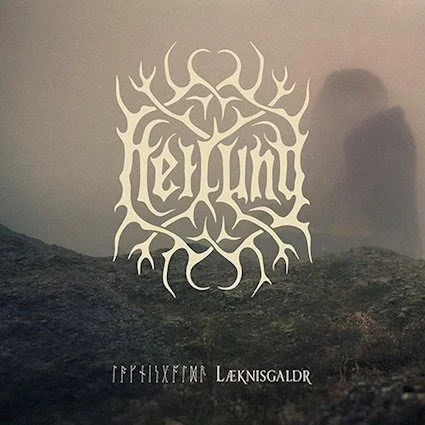
After a restful hiatus, Heilung is waking up. This month, the world famous ritual collective is entering LAVA Studios to begin recording their highly-anticipated fourth full-length studio album.
While fans around the globe eagerly await their next album, today, Heilung is excited to share the first single from Sagas, a collection of recordings that core members Kai Uwe Faust, Maria Franz and Christopher Juul created in collaboration with Ninja Theory for the award-winning video game Hellblade II: Senua’s Saga. Unreleased until now, “Læknisgaldr” heals afflictions of the mind, body and soul through the simple act of ritual repetition.
“‘Læknisgaldr’ is the first song we are sharing from our in-between albums release Sagas, which collects sounds from the time we traveled to the land of Hellblade II: Senua’s Saga”, Heilung says. ”We see Sagas as its own branch within Heilung’s musical universe. These recordings show a cinematic, immersive and environmental side of what we do and were shaped very specifically by our work with Ninja Theory and the world of Hellblade.
“The first sound you hear on ‘Læknisgaldr’ was not made by anything from our reality. During the recording process, somehow, while playing with real human bones and breath, we managed to capture a ghost in the studio!” Heilung continues. “The video tells the second part of a greater story about trauma. Like Hellblade II: Senua’s Saga, it deals with what causes trauma to our minds and, most importantly, how to heal it”.
Sagas holds a special place in Heilung’s discography. While the recordings capture Senua’s epic journey through 9th century Iceland, they took on a life of their own after Franz, Faust and Juul returned home inspired from a 10-day trip across the country’s ice caves, rivers, waterfalls, beaches and volcanoes. These forces of nature inspired them to write far more material than could be used in the game, including the new single “Læknisgaldr”.
Heilung envisions “Læknisgaldr” as a song of healing. It is rooted in a belief from the early medieval period that language is connected to the condition of the human body. By naming an affliction, it becomes defined, contained and open to ritual healing. With each repetition of the song’s percussive beat, its affliction weakens, until it is guided toward dissolution by soothing tribal chants.
“In situations that create acute stress, shock or danger, the body releases adrenaline, preparing the muscles to go into a fight-or-flight state or the so-called freeze response”, Heilung core member and throat singer Kai Uwe Faust explains. “In nature, mammals use neurogenic tremors to shake off this built-up adrenaline once the danger has passed”.
“We humans, being socially conditioned, see trembling with fear as a sign of weakness”, Faust continues. “Or we find ourselves in dangerous situations that last for a long time, where the body simply has no chance to release it. As a result, the adrenaline builds up both in the muscles and in the body. Only in a state of absolute safety and security - and often with the help of therapy - does the possibility arise to develop these neurogenic tremors and free the body from the built-up energy. If this energy stays trapped in the body, it can lead to a range of illnesses.
“In the video for ‘Læknisgaldr’, you can see how the warriors reach this feeling of absolute safety and security in the forest after the battle is over. There, with the help of psychedelics, they are guided into the neurogenic tremors”.
Line-up:
Kai Uwe Faust
Christopher Juul
Maria Franz
Production Credits:
Recorded, Mixed and Mastered at LAVA Studio
Produced, Mixed, Mastered and Engineered by Christopher Juul
Cover Art:
Kai Uwe Faust
Christopher Juul
Maria Franz
Adrien Bousson