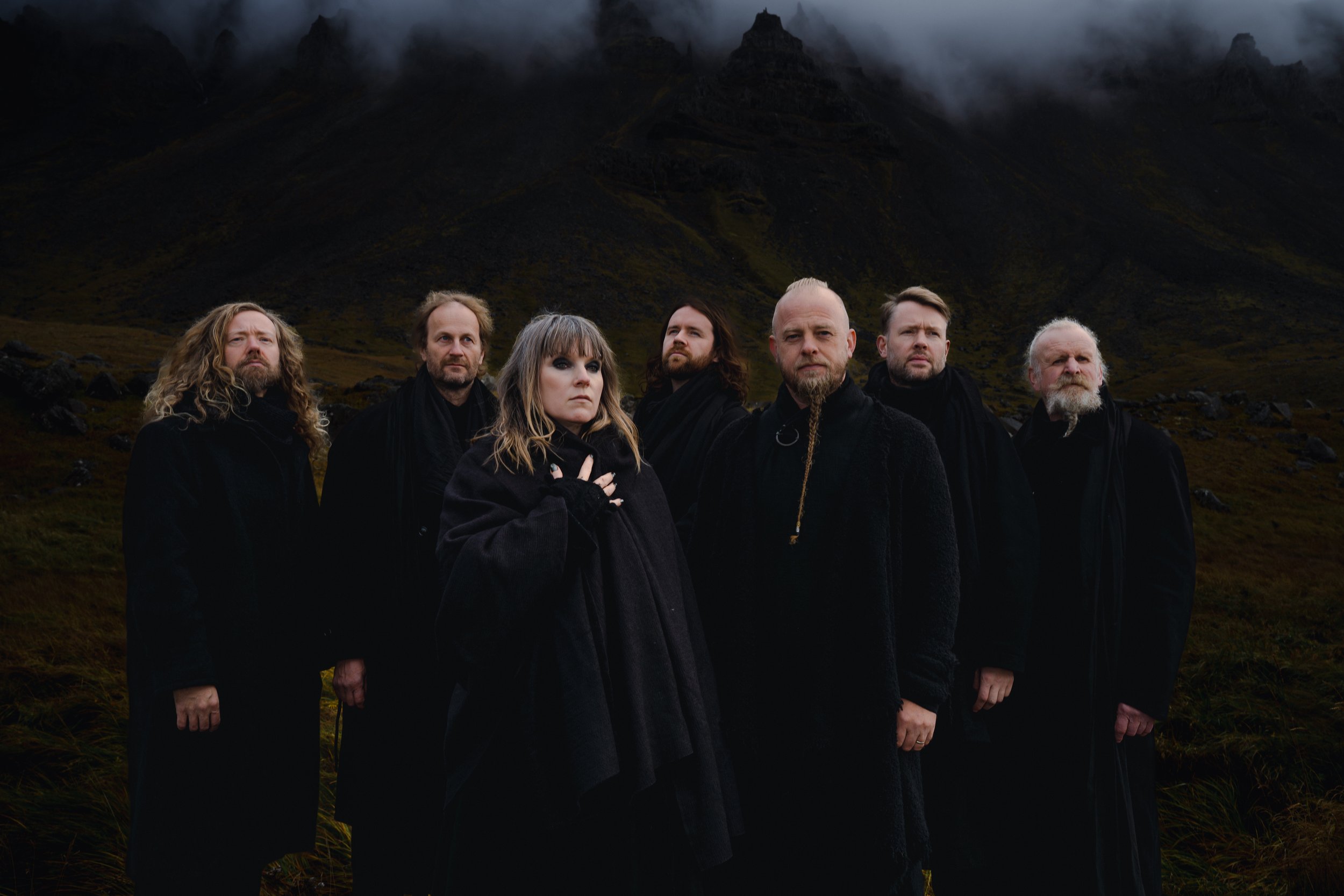
Like those of you reading, Wardruna’s Helvegen has a special place in my memory. I still recall hearing it for the first time in Vikings which then compelled me to look up the band, thus beginning a whole new journey through a style of music which would then - unbeknownst to me at the time - become the foundation of my professional career many years later. But many of you have stories of similar (or even greater) influence and resonance with Helvegen in particular, and it has indeed become the song of the Wardruna fandom. It has, in its own way, become a core part of the repertoire of what we can call a neopagan song tradition - though time will tell if said tradition truly achieves futurity.
But I digress. Helvegen is a song with immense emotional weight for listeners of Wardruna. It is for this reason that it is a bold endeavour indeed to revisit it and alter it fourteen years since its release. Because Wardruna has changed in the years since - as much as the members and artists behind Wardruna feel that they’ve always been doing the same thing, fans can very much hear changes in style and character from the Runaljod trilogy into Kvitravn, and even more so from Kvitravn into Birna. It is for this reason that the thought of revisiting a foundational song in the band’s corpus with a new perspective makes for a deeply interesting artistic project from the outset.
But there is always a risk in “playing” with a work of art that carries as much weight as Helvegen, especially because there is also the possibility of listeners understandably listening to the new song or watching the new video without context - that’s the nature of feeds - and being given a whole new version of a song that they love without fully understanding why there even is a Helvegen II to begin with. As such, I think it's important to start with why this new song and video is different from the first, rather than how. For this, we need to turn to Einar Selvik’s own statement on the piece:
“For some years now, we have been quietly working on a new recorded version of Helvegen. Not to replace the original, but to reflect what the song has gradually become.Over the years, it has found its way into the lives of people around the world in ways we could never have anticipated. We have received countless stories of Helvegen finding its way into funerals and memorials, weddings and births, and moments of both profound grief and great joy. It has become part of communal singing traditions in places far beyond Scandinavia and has found new voices in many different languages.
At some point, we realized that the song no longer existed only as the version we recorded in 2012. It had become something larger, shaped by the people who embraced it and by the countless moments in which it had been given a place and a purpose. This recording is our way of acknowledging that journey.
If this new recording offers anything beyond itself, it is to encourage a renewed relationship with song, not only as something we perform or listen to, but as something that can accompany us through life.
A tradition does not truly survive when it is merely remembered, but when it is lived.”
I have bolded the segments of Selvik’s artistic statement that I believe give us the most insight into the motivations and inspirations behind revisiting Helvegen. The last sentences I think are the most salient: that Helvegen II is meant to invite new perspectives and interpretations of this song to encourage others to do the same, and to open doors for new meanings to be found within the song to keep it alive rather than simply remembered.
To summarize what we read in these bolded segments, Selvik is essentially working with the idea that Helvegen itself has become a folk song: a song that takes on a life of its own through different interpretations both professional and vernacular, crafted and improvised. But in order to fully realize this, it needs to be freed from the confines of popular recorded music in which the original recording is the definitive version of a song, which constrains further interpretations to the standards set by the original recording.
In essence, by revisiting the song and offering a second look at it, Wardruna themselves are inviting others to do the same, and opening the door for Helvegen to realize its potential as a song that lives not in recordings, but in everyday life. This point is only emphasized by the initial statement that the new recording is not meant to replace the original - Selvik is rejecting the paradigm of definitive recordings altogether. Taken in sum, Helvegen II is at its heart a project of fully realizing a new invented tradition hidden within this relatively young music genre.
Ok, so with “artist intent” established, I think we are now well-equipped to dive into the dark waters of Helvegen II and see what Wardruna has in store for us with this well-trodden and beloved song. Shall we?
First things first, the new video from Tuukka Koski is, as always, stunning. He is such a versatile artist, and here he is flexing the more cryptic side of cinematography to visually tell a story that is unsettling but that still fits in with the songs overall story and narrative. The dancer Sofia Rujia playing the part of the departing spirit of the dead portrays through movement the confusion, uncertainty, and fear one would assume would be associated with the first moments of death, but as the video goes on, the spirit gains confidence and stability until the last steps into the ocean’s waves. To me, the visual media accompanying music is at its best when it illuminates deeper meanings and interpretations of the song, rather than simply decorating the song. Here, the cinematography and choreography very much accomplish the former, bringing life to the dead who can’t sing for herself in the song.
Musically, the first noticeable difference in the new interpretation of Helvegen is Selvik’s singing voice. Of course, everyone’s voice changes after 14 years (especially as a professional singer) but it is the technique itself that grabs my attention: rather than singing from the diaphragm as he does in the original recording, he is very much holding the melody in his head and throat in the new version. The change in timbre is noticeable. In place of a heroic or triumphant voice, we have one that is itself wavering, almost quivering as if holding back tears. I don’t know if this is intentional, but the approach here is very much reminiscent of Karelian laments and feels much more vulnerable. The perspective from the singer is simply much more believable in the newer style and does a better job of communicating the actual essence of the song - that is, grief and mourning. As a listening exercise, try it yourself: listen to Helvegen I and II and pay close attention to the different stories being told by merely the different singing styles. (The use of varied singing styles to tell a story is something Selvik himself has done before to great effect in the song Skald, which might deserve its own closer analysis in the future for those of you more interested in vocal performance, arrangement, and composition).
In terms of instrumentation, orchestration, and overall arrangement, Helvegen II is a more vibrant take on the composition, reflecting Selvik’s development as a composer in the years since the original release. Of course, there is much to be said about the austerity and simplicity of the original recording, primarily comprised of drones and percussion, but comparatively speaking, Helvegen II breathes in a way the previous arrangement does not. The instrumental parts weave and dance effortlessly between one another, leading to a musical work that simply has much more life in it than its predecessor. Helvegen I is, apt to the genre name to which it is often attributed, heard darkly as if listened to through a misty memory. Helvegen II, on the other hand, feels very much alive and of the present moment.
There is finally the question of the new lyrics at the song’s conclusion. Whereas the original ended with the beloved recitation of the Hávamál’s stanzas 76-77, Selvik omits the direct quotation of Viking age cultural material to instead add original lyrics:
Hearken all realms
High in heavens
Deep in the earth,
our words work
They know the way
They find your steps
To you who listened, to you who sang
Let our hands part, one final time
This feels far more personal rather than the Vikingist pastiche of the original, though that of course worked in its own way. These new lyrics are in line with Selvik’s determination at the outset to approach Helvegen II as something that lives in the here and now. To this end, these final lyrics resonate well with that goal. Moreover, their visual parallel in the music video is rather powerful, with Selvik and Rujia releasing their hands from one another as the spirit embarks on the journey in death that she must make alone. An evocative and relatable moment to anyone who has lost someone indeed, moreso than an austere recitation from the Hávamál.
To wrap up these first thoughts, what I’m most interested in with this track is the implications behind Selvik’s revisiting of this timeless track in the first place. Creatives of all walks of life, be they writers, musicians, or artists, don’t tend to go back to their earlier works on a whim, but rather when they feel there is something to be gained or inspiration to be found when faced with the raw potential of one’s first artistic works when the burdens of success and expectation are far lighter. As I began this review, I noted the stylistic trajectory and development of Wardruna from their Runaljod trilogy through to Birna. The question for me, then, is not only why Selvik might have been rooting around in his older works, but what might become of such an endeavour as rearranging and rewriting an old gem? It is not a light task what Wardruna accomplished here, but also one with less clear motivations, at least not to the same more immediate benefits as releasing entirely new music altogether.
Helvegen II hence raises more questions than it does answers. I look forward to seeing what the long term results might be from Selvik revisiting his older works, and how such forays into the past might sew the seeds for future projects.
Thank you guys for reading This post here is foreshadowing some major restructuring and overhauls I’m doing for the Nordic Sound come 2027, so I hope you enjoy this demo, if you will, for what the future looks like for the Nordic Sound. I hope you all have a lovely day, and I look forward to hearing your thoughts on Helvegen II.